

Bladder cancer: what you need to know
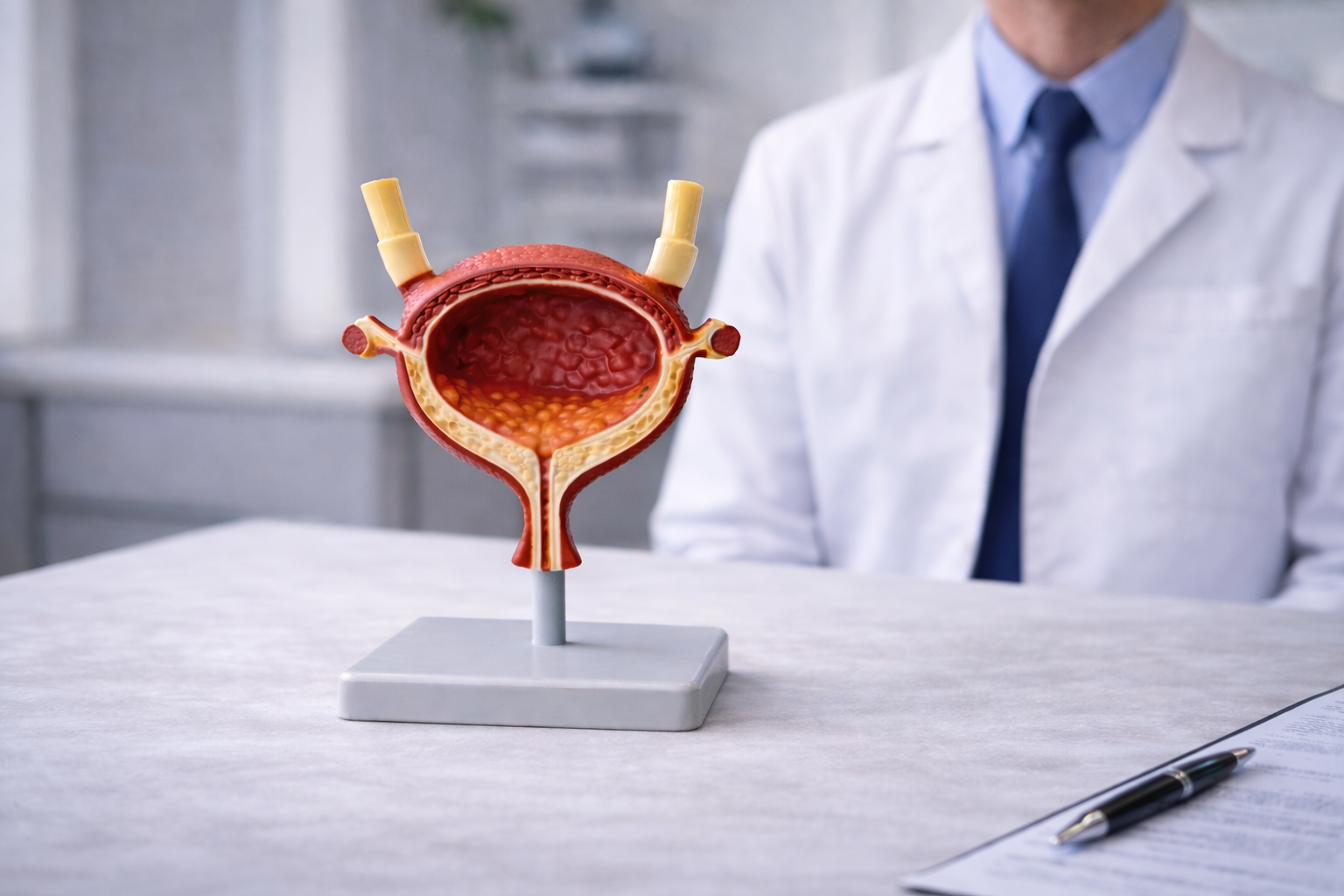
Every year, thousands of people receive a diagnosis that changes their lives. Bladder cancer is one of the most common cancers of the urinary system. It is often detected late, when treatment becomes much more difficult. However, in the early stages, it responds well to treatment, and the prognosis can be quite favorable.
This article will help you understand how long it takes for bladder cancer to develop, which symptoms to take seriously, and what to do if you or your loved ones find yourselves in a situation where the diagnosis has already been made.
What is bladder cancer and how does it develop?
The bladder is a hollow muscular organ that stores and removes urine from the body. It is lined with transitional epithelium, or urothelium. It is in the cells of the urothelium that the malignant process begins. This type of tumor is called urothelial carcinoma, or transitional cell carcinoma.
The disease develops gradually. First, mutations occur in the cells of the mucous membrane. This is facilitated by the influence of carcinogens, chronic inflammation, and genetic malfunctions. The cells begin to divide uncontrollably, forming a tumor of the bladder. In the early stages, it can remain within the mucous layer for years without growing deeper into the wall.
Other histological types are less common: squamous cell carcinoma and adenocarcinoma. They are more aggressive and respond less well to standard treatment.
What are the main causes and risk factors for bladder cancer?
Bladder cancer develops under a combination of factors.
Smoking is one of the most common causes. Tobacco smoke contains powerful carcinogens. They are absorbed into the blood, filtered by the kidneys, and concentrated in the urine. Since the fluid is in contact with the walls of the organ for a long time, these substances affect the mucous membrane.
The second significant factor is prolonged contact with industrial chemicals: aromatic amines, nitrosamines, dyes. People working in the chemical, petrochemical, rubber, and leather industries, hairdressers, and printers are at risk.
Age also plays an important role: most patients are over 55 years old. Bladder cancer in men is diagnosed about four times more often than in women. However, bladder cancer in women is often detected at later stages. This is because cancer can be confused with gynecological problems or urinary tract infections.
Additional risk factors include chronic inflammation, previous chemotherapy (especially with cyclophosphamide), and radiation of the pelvic organs.
Stages of bladder cancer and their significance for treatment
The stages of bladder cancer are determined according to the international TNM system. It takes into account three parameters: the size and depth of tumor invasion (T), lymph node involvement (N), and the presence of distant metastases (M).
Oncologists distinguish four main stages.
- The first is superficial bladder cancer (stages Ta, T1, Tis). The tumor is confined to the mucous or submucous membrane and does not invade the muscle layer. At this stage, treatment gives the best results.
- The second stage (T2) is invasion of the muscle layer, but without spreading beyond the organ.
- The third stage (T3-T4) is spread to surrounding tissues: fatty tissue, prostate, uterus, pelvic walls.
- The fourth stage is diagnosed when there are metastases in regional lymph nodes or distant organs - lungs, liver, bones.
The stage of the urinary system tumor directly determines the treatment tactics. In the early stages, more gentle methods are used. In the later stages, more aggressive methods are used, and therapy is aimed at maintaining a normal life and prolonging it.
The first symptoms of bladder cancer that should not be ignored
The symptoms of bladder cancer in the early stages resemble common cystitis or urolithiasis.
- Blood in the urine (hematuria) is the first sign. The urine becomes pink, red, or brown in color. Interestingly, a person may notice a change in urine color once, and then again several weeks later.
- Pain when urinating, frequent urge to urinate
- Feeling of incomplete emptying
- Discomfort in the lower abdomen.
- Lower back pain occurs in the later stages when the tumor compresses the ureters.
- Swelling of the legs.
- General weakness.
- Weight loss.
The signs of bladder cancer and urethral cancer are not specific. They can also occur in other diseases. But that is why it is so important not to self-medicate and not to wait for the symptoms to go away on their own. Always seek medical help.
When should you see a urologist or oncologist?
See a doctor immediately as soon as you notice blood in your urine. Do this regardless of whether it was a one-time occurrence or has happened several times.
Discomfort during urination that does not go away after a course of treatment for cystitis, pain in the pelvic or lumbar region for no apparent reason, any neoplasm of the bladder accidentally detected during an ultrasound scan are valid reasons to start a detailed diagnosis.
If you have been smoking for many years, have worked with chemicals, or have relatives with cancer of the urinary system, undergo regular preventive examinations.
How bladder cancer is diagnosed: modern methods
Diagnosis of bladder cancer begins with collecting medical history and urine tests. A lab technician examines the cellular composition of the urine for the presence of atypical elements.
The first instrumental method of testing for bladder cancer is ultrasound. An ultrasound examination allows you to see the walls of the organ, detect volumetric formations, and assess their size.
To clarify the stage and extent of the process, CT of the bladder (computed tomography) and MRI of the bladder (magnetic resonance imaging) are used. These methods provide a three-dimensional image of the organ, surrounding tissues, and lymph nodes.
The final diagnosis is made only after morphological examination of the tissue. Therefore, bladder biopsy is a mandatory stage of diagnosis. A tissue sample is taken during cystoscopy, an endoscopic examination of the inner surface of the organ. The doctor inserts a cystoscope through the urethra, which allows the doctor to see the mucous membrane, identify suspicious areas, and take material for analysis.
Main methods of treating bladder cancer
Treatment for bladder cancer is selected individually depending on the stage, type of tumor, general condition of the patient, and a number of other factors.
For superficial tumors, the main method is transurethral resection (TUR) — removal of the bladder tumor endoscopically without incisions. After the operation, intravesical chemotherapy or immunotherapy is performed. This involves the administration of drugs directly into the organ cavity to reduce the risk of recurrence.
For invasive bladder cancer, treatment may include radical cystectomy. This is a procedure to remove the organ along with the regional lymph nodes. In men, the prostate is also removed, and in women, the uterus and part of the vagina. After that, the surgeon creates a new pathway for urine to flow.
Chemotherapy for bladder cancer can be used before surgery (neoadjuvant) to reduce the tumor, after surgery (adjuvant) to destroy possible micrometastases. It can also be used for inoperable forms.
Radiation therapy is used either as an alternative to surgery in patients for whom surgical intervention is contraindicated. It can also be combined with chemotherapy in organ-preserving treatment. Sometimes it is used in metastatic cancer to control pain and improve quality of life.
Modern oncology is actively developing immunotherapy. These are drugs that stimulate the immune system and allow the body to fight the tumor on its own.
You can make an appointment with oncologists at the Oncare Medical Center on our website or by phone.
Life after treatment: rehabilitation and monitoring
The completion of active treatment for tumors of the genitourinary system is not the end of the road, but the beginning of a new stage. The superficial form of this disease is prone to recurrence. In 50-70% of patients, the tumor may reappear within the first five years. Therefore, regular monitoring is not a recommendation, but a necessity.
The standard monitoring regimen includes cystoscopy every 3 months during the first year, then less frequently, depending on the risk group. At the same time, urine tests, ultrasound, and, if indicated, CT or MRI scans are performed.
Rehabilitation after radical cystectomy can take several months. It involves physical recovery, adaptation to a new method of urination (if the organ has been removed), and psychological support. The changes associated with the operation affect quality of life, sexual function, and self-esteem — and all of this needs to be worked on with specialists, not alone.
What should you not do if you suspect or are diagnosed with bladder cancer?
First and foremost, do not delay. Every week of delay with invasive cancer is lost time.
Do not self-medicate or attribute symptoms to cystitis. Do not postpone cystoscopy due to fear or discomfort.
If a bladder cyst or any volumetric formation is detected during an ultrasound, do not ignore your doctor's recommendation for additional examination. Most cysts are benign. However, only a specialist can distinguish them from malignant formations after a detailed diagnosis.
Do not refuse the prescribed treatment because of fear of side effects, do not replace it with unconventional methods, and do not look for a “magic cure” on the Internet. Modern oncology has real, scientifically proven tools — and they work.
Prevention and early detection of the disease
It is impossible to eliminate the risk of developing cancer, but it is quite possible to significantly reduce it.
The most effective step is to quit smoking. The risk of developing cancer in former smokers gradually decreases after quitting smoking. If your work involves chemicals, use protective equipment and undergo regular medical examinations.
Drink plenty of fluids. A balanced diet with plenty of vegetables and fruits will also be beneficial.
If you are at risk, have a general urine test and an ultrasound scan of your abdominal organs every year. Ureteral diseases detected at an early stage can be successfully treated.
Conclusion
Cancer of the ureter and urinary bladder is a serious disease, but it is not a death sentence. With timely detection and proper treatment, the prognosis can be very favorable. The key to success is paying close attention to your body, being ready to see a doctor at the first alarming symptoms, and taking a responsible approach to treatment and follow-up.
Cancer of the ureters and lower urinary tract requires specialized care. Do not try to deal with it on your own. Consult oncologists who have experience working with this particular pathology.
FAQ
No, not always. Hematuria can be the result of urolithiasis, infections of the ureters, trauma, or benign formations. However, any blood in the urine is a reason to see a doctor immediately, as it is impossible to rule out cancer without an examination.
The rate of development depends significantly on the type and degree of malignancy of the tumor. Low-aggressive superficial forms remain stable for years. High-grade invasive tumors can progress rapidly, within months.
Yes. When detected at stage Ta or T1, the five-year survival rate exceeds 90%. Superficial cancer responds well to endoscopic treatment, and most patients return to their normal lives.
The first year - every 3 months (cystoscopy, urine tests). The second and third years - every 6 months. Then - once a year, if everything is fine. The specific schedule depends on the stage and risk group for recurrence. It is determined by the doctor on an individual basis.
Yes. Smoking after treatment significantly increases the risk of recurrence. Quitting nicotine, moderate physical activity, a balanced diet, and avoiding contact with chemical carcinogens reduce the likelihood of recurrence.